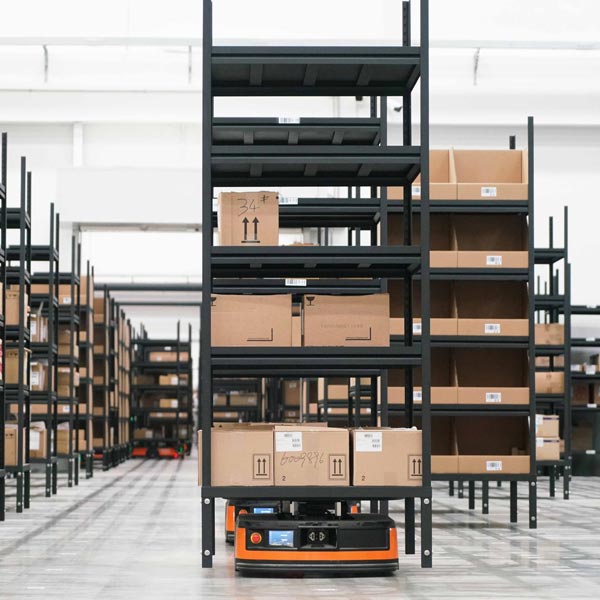
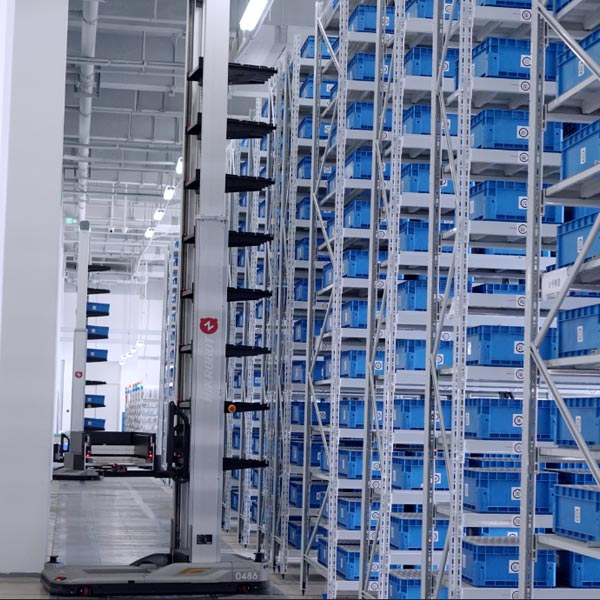
Keymas work with warehouses across the UK transform their operations using cutting-edge Autonomous Mobile Robots (AMRs). These intelligent machines navigate dynamic environments, optimise material flow, and reduce manual handling—enabling faster, safer, and more scalable logistics.
Warehouse robotics are transforming the way modern fulfilment and distribution centres operate. At Keymas, we help UK warehouses adopt Autonomous Mobile Robots (AMRs) and robotic systems that streamline workflows, enhance safety, reduce labour dependency, and improve throughput all while integrating seamlessly with your existing warehouse software and management systems.
Why Choose AMRs?
Unlike traditional conveyor belts or AGVs, AMRs use advanced sensors, AI, and real-time mapping to autonomously move goods through the warehouse with minimal infrastructure changes. Whether you’re picking, sorting, replenishing, or transferring pallets, AMRs adapt to your operation and scale as your business grows.
Common AMR Applications
Benefits of Deploying Robotics & AMRs
AMRs and robots deliver measurable improvements across key performance indicators in the warehouse:
Improved Throughput
Robots automate repetitive transport tasks, enabling faster order cycles and improved responsiveness to demand.
Lower Labour Costs
Free your workforce from travel and repetitive tasks, allowing them to focus on higher value work.
Enhanced Safety
Advanced sensors and collision avoidance systems ensure safe operations around people and equipment.
Flexible Integration
AMRs are designed to work with existing infrastructure with minimal disruption, integrating with common warehouse management systems (WMS), ERP and automation software.
Scalable Automation
Add robots gradually and expand your fleet as your operation grows — no major upfront infrastructure changes required.
Our Expertise
At Keymas, we don’t just supply robots — we engineer complete, integrated automation systems tailored to your operation.
Site Assessment & Consultancy
We begin with a detailed understanding of your workflows, throughput goals and constraints.
Software & WMS Integration
Our robotics integrations work with your current warehouse management system and back-office software, giving you full data visibility and control.
Fleet Management & Traffic Optimisation
We deploy fleet control software that manages robot paths, avoids congestion and enhances utilisation.
Support & Performance Analytics
After go-live, we provide continued support, monitoring and reporting to help you extract maximum value from your robotic investment.
AMR Use Cases — Where Robotics Add Value
Examples of where warehouse robots are commonly applied:
Picking & Packing Support
Robots bring goods to operators or carry picked products to packing stations.
Putaway & Storage Movement
AMRs transport goods from goods-in zones into storage, optimising labour.
Dynamic Transport Routes
Unlike fixed conveyors, AMRs adapt in real time to changing order patterns and warehouse traffic.
Why AMRs are the Future of UK Warehouses
UK warehouses today operate under pressure from:
Robotics help meet these challenges without the disruption or infrastructure cost of traditional automation.
Ready to Explore Warehouse Robotics?
Whether you’re considering your first automation project or expanding an existing fleet, our team can help you assess the right robot solutions for your warehouse.
Discuss your AMR project with our automation specialists
What are AMRs (Autonomous Mobile Robots) in a warehouse?
Autonomous Mobile Robots (AMRs) are intelligent robots that move around a warehouse using onboard sensors and mapping software. They transport totes, cartons or pallets without fixed guide paths, adapting dynamically to the warehouse layout and working safely alongside people.
What is the difference between AMRs and AGVs?
AGVs (Automated Guided Vehicles) typically follow fixed routes using magnetic tape or reflectors. AMRs navigate more flexibly using sensors and real-time mapping, allowing them to reroute around obstacles and adapt to layout changes. This makes AMRs more suitable for dynamic warehouse environments.
What warehouse tasks can AMRs automate?
AMRs are commonly used to automate travel-heavy tasks such as:
They significantly reduce non-value-added walking time.
Do AMRs replace warehouse staff?
In most UK warehouse deployments, AMRs support staff rather than replace them. They remove repetitive transport tasks so operators can focus on higher-value activities such as picking, packing, quality control and exception management.
How do AMRs improve picking productivity?
AMRs reduce travel time between pick locations and workstations. By keeping operators supplied with work and eliminating unnecessary movement, warehouses often see major productivity improvements without increasing headcount.
Can AMRs integrate with our WMS and ERP systems?
Yes. AMRs are typically integrated via APIs or middleware into warehouse management systems (WMS), ERP platforms and automation software. This enables real-time task allocation, inventory updates and operational visibility.
Do we need to redesign our warehouse to deploy AMRs?
Usually not. AMRs are often selected because they require minimal infrastructure changes. Some layout optimisation may be recommended — such as defining safe travel lanes or pickup/drop points — but major structural changes are rarely necessary.
How safe are AMRs around people?
Modern AMRs are equipped with sensors and obstacle detection systems to operate safely in mixed human environments. A proper deployment includes risk assessment, speed zoning and operational testing to ensure compliance and safety.
How long does it take to deploy AMRs?
Deployment timelines depend on project scope, integration complexity and fleet size. Compared to fixed automation like conveyors, AMRs can often be implemented more quickly due to reduced infrastructure requirements.
What is a typical ROI for warehouse AMRs?
ROI varies based on labour costs, travel distances, order volumes and accuracy improvements. Many UK warehouses evaluate ROI based on labour reduction, productivity gains and scalability without proportionate headcount growth.
How many AMRs would we need?
Fleet sizing depends on:
Simulation or throughput modelling is typically used to determine the correct fleet size.
Can AMRs work alongside conveyors or sortation systems?
Yes. Many warehouses operate hybrid automation environments where AMRs feed conveyors, buffer zones or sortation systems. Proper integration ensures smooth handoffs and real-time tracking.
We can provide expert advice and bring our knowledge and experience to your project.
Contact us about your projectKeymas Ltd, Office 3 Wassell Grove Business Centre, Wassell Grove Lane, Hagley, Stourbridge, West Midlands, DY9 9JH UK
Keymas Limited is company registered in England and Wales with Company No. 2029255


